
Feature Film Scripts
Finished Scripts
Sgt. Meat
War Drama
(As-Told-To)
status:
Completed.
"The truest war movie you will ever see."
Shit that goes wrong (bullet list)
Lightning striking Meath and his squad in basic training is not a good omen.
Meath is sent on his first mission without bullets.
His vehicle at the training base in the States constantly breaks down, but he is assured he will be issued a new vehicle when they go to Iraq. But when he arrives in Iraq, guess what? They lied. Same vehicle. √
When his vehicle inevitably breaks down in the desert, his lieutenant tells him to stay with it and they’ll be right back for him. They return two days later! So much for “No man left behind.”
Meath is given a malaria pill that makes him hallucinate (the Army knew about this “side effect”), and in the middle of the night yells “Bang, bang, bang!” at a possible intruder, thinking he’s firing his 9mm pistol.
Meath is nearly killed by a mortar round while in the porta-john, but the round is a dud, landing five feet away but not exploding. His fellow soldiers laugh about it when he emerges: “Haha, bet you were scared shitless!”
Meath is nearly killed by a tank gunner who loses his grip on the tank turret’s 50-caliber machine gun and lets it swivel wildly, firing away toward Meath and his squad.
Meath is nearly killed by “wedding rain”—bullets that fall from the sky after being shot in a wedding celebration a couple miles away.
The Iraqi National Guard were allies of the Americans. Meath almost kills a bunch of them by accident, thinking they’re the enemy. Thankfully, the machine gun he grabs jams and doesn’t fire, giving him a moment to realize his mistake in time.
Meath is nearly killed by a 12-year-old (you read that right) Iraqi National Guard trainee who loses control of his semi-automatic rifle while learning to fire it for the first time.
Meath loses his chance to go home early when a friendly lieutenant who was going to file the paperwork gets a random piece of shrapnel through the head while in his office typing an email to his wife.
A sergeant at a checkpoint randomly shoots up a carful of Iraqi citizens for no reason, and orders Meath to take them to the morgue. When Meath dumps them there, he finds tens of thousands of American dollars on their bodies. As he starts to bundle the money into his jacket to take with him, he is startled by the sudden arrival of two large Iraqi morgue attendants. Now going on no sleep for 72 hours, Meath instinctively draws his 9-mm pistol and aims it at the two unarmed men….
Wanna know what happens next?
Read the script.
And it’s all true!
George Clooney would love this one!
This is the true “as told to” story of Sgt. Mike Meath, a chiropractor and Iraq War veteran, whose real-life experiences in Iraq as a medic resemble the absurdities of Catch-22, but with a modern twist. Mike was nearly killed half a dozen times, in very unheroic, unglorious ways—and that’s not even the half of it! I have taken his stories, shared over coffee, and transformed them into a script. The result is an engaging and entertaining narrative about war, full of chaos and absurdity—yet it’s all true. Sgt. “Meat” is not a typo, but rather a nickname some of Sergeant Meath’s buddies call him.
For me, writing this script was a way to remind people of the total absurdity of war. But I did not do any sermonizing. I just wrote Mike’s true story. That is sufficient. Whatever your opinions about war—whether you are a pacifist or a patriot, Mike’s story is a hell of a ride! I believe “Sgt. Meat” will be the most authentic war movie you’ll ever see.
I realized recently how HUGE the potential audience of this movie is:
nearly 10 million American veterans and current soldiers, plus about 25 million males aged 18 to 30. Even with overlap, that’s about 30 million. Add to that non-military people in the U.S. and abroad with varying opinions on the American wars in Afghanistan and Iraq, and that’s a LOT of people! Also, friends and relatives of veterans may watch it to understand the war experience—especially if the veteran has PTSD. Mike has said that reading the script has resurfaced difficult memories, but has also been a healing experience for him.I was doing research to write something highlighting the absurdity of war when my chiropractor moved back to Canada, and the new chiropractor I found was a former medic in Iraq who started telling me crazy stories every time I visited. So I asked him to tell me the whole story.
500 word synopsis
“Sgt. Meat” is the true story of Sergeant Michael Meath, a U.S. Army medic, whose experiences in Iraq highlight the chaos, incompetence, and sheer absurdity of war. Rather than focusing on heroism or reflection, the story presents Meath’s many near-death experiences as a product of both the Army’s dysfunction and the randomness of war.
The narrative kicks off with an ominous event during basic training, when Meath and his squad are struck by lightning, foreshadowing the absurd and dangerous situations that will follow. On his first mission, Meath is sent out without any bullets. (Yes, you read that right.) Throughout his deployment, Meath finds himself facing death multiple times, always in ridiculous and unpredictable ways, far from the heroism he imagined when he enlisted.
While in training in the U.S., his vehicle breaks down so many times he nicknames it “Broke Down Betty.” Despite assurances that he would receive a new vehicle upon arriving in Iraq, Meath finds himself stuck with the same unreliable truck. When “Betty” inevitably breaks down in the desert, his lieutenant orders him to stay with the vehicle, promising to return shortly. Meath is left stranded for two days before being rescued, a clear mockery of the Army’s “No man left behind” mantra.
Meath’s brushes with death escalate in intensity. A mortar round hits right next to the porta-john he’s using, but it’s a dud, and his fellow soldiers laugh and joke about it when he emerges. (“I’ll bet you were scared shitless!”) In another instance, a tank gunner loses control of a 50-caliber machine gun, sending bullets wildly in Meath’s direction, nearly killing him and his squad. Another close call comes from an Iraqi wedding celebration miles away, where celebratory gunfire rains down on Meath when is “safe” on base. In an intense firefight, Meath nearly shoots a group of Iraqi National Guard soldiers, mistaking them for enemies. (The Iraqi National Guard were U.S. allies.) Luckily, the machine gun jams, giving him just enough time to realize his mistake. In another instance, a 12-year-old Iraqi National Guard trainee accidentally loses control of his semi-automatic rifle, sending bullets flying around Meath, who once again narrowly escapes harm.
The story takes a darker turn when a friendly lieutenant, who was about to file the paperwork for Meath’s early release, is killed in his office by a stray piece of shrapnel while typing an email to his wife. Later, Meath is tasked with transporting the bodies of civilians who were randomly killed by a gung-ho sergeant at a checkpoint. Discovering over a hundred thousand dollars in cash on the bodies, Meath contemplates taking it, only to be startled by the arrival of two Iraqi morgue attendants, causing him to draw his pistol in a moment of sleep-deprived panic. (You’ll have to read the script to know how that episode ends.)
Sgt. Meat is not about heroism or moral reflection, but instead focuses on the absurdity, randomness, and incompetence that define Meath’s experiences in Iraq. Survival is as much about navigating the dysfunction of one’s own side as it is about avoiding enemy fire, and it often feels like a matter of pure chance.
Helix Infinity
Sci-fi Thriller
status:
Completed.
Helix Infinity explores the perilous fusion of virtual reality, quantum computing, and the mysteries of consciousness. When Vasquez Virtual’s controversial founder, Rodrigo Vasquez, decides to power his revolutionary virtual reality hardware/software system, Helix Infinity, with a military-grade quantum computer, two players wearing next-generation VR haptic suits become trapped in digital worlds, with no clear way back.
Jean-Paul Mbengue, a pro-gamer and champion parkourist, is stuck in Monster Planet Inferno, an ultraviolent hellscape where grotesque creatures hunt him relentlessly, forcing him to fight for survival as his grip on reality begins to slip. Meanwhile Tarina Dillingham, a 14-year-old girl with vitiligo, happily explores a serene, mind-bending puzzle world, where the illusions of the game offer her a peace and joy that were not available to her in the real world. While Jean-Paul battles for his life, Tarina resists rescue altogether.
Vasquez Virtual staff, in over their heads, scramble to retrieve the players before Jean-Paul is killed and Tarina wanders too deep to ever come back. With both players in very real danger, Vasquez Virtual must decide who to save first. Tarina’s aunt is the game designer at Vasquez Virtual, and the team makes an emotional decision to save Tarina first, since she just created a new door, and may be forever lost in a new world whose boundaries go far beyond the original game design. But when Jean-Paul receives a crippling wound that starts to bleed profusely, it becomes apparent they may have made the wrong decision. Haptics engineer Akarsh Rao uses the company’s only remaining haptic suit to enter Monster Planet Inferno and make contact with Jean-Paul, but is quickly killed. With Jean-Paul’s and Tarina’s suits needed as their path back to this world, and Akarsh’s lava-fried body occupying the only other suit, Rodrigo Vasquez comes up with an extraordinary plan—which may or may not work.
Game fans watching don’t realize that Jean-Paul is in mortal danger. After all, it’s just a game, right? Will Jean-Paul survive? Will Tarina come back to this world? When the dust settles, will Rodrigo Vasquez go to prison, or will his company’s IPO make him the video game world’s first billionaire?

1500 word treatment
Treatment: HELIX INFINITY
At the helm of Vasquez Virtual stands Rodrigo Vasquez, a brilliant yet ruthless 31-year-old entrepreneur. Rodrigo’s path to success was shaped by hardship. He hacked university computers at the age of 12, desperate to escape his humble beginnings as the son of a night janitor in Silicon Valley office buildings. Now, Rodrigo is poised to launch Helix Infinity, his most ambitious project yet—a 6th generation virtual reality system that uses the latest tech that makes you feel you are in another reality.
The Helix Infinity combines full-immersion technology with haptic suits, brain-computer interfaces, video in contact lenses (such technology currently exists). This hardware, designed by Vasquez Virtual’s hardware engineer, Akarsh Rao, pushes the boundaries of what virtual reality can achieve, making it possible for players to feel as though they’re stepping into entirely new dimensions. Rodrigo sees Helix Infinity as his ticket to toppling his rival, Dragon VR, the company that stole his first game out from under him years ago. The pressure is mounting, and Rodrigo knows that the launch must go perfectly. Leaving nothing to chance, he makes the reckless decision to link the system to a military quantum computer—unknown to players and his staff.
The debut is staged as a massive live spectacle at the Oakland Arena, and streamed worldwide. Thousands watch in person, millions online. The centerpiece is Jean-Paul Mbengue, the world’s most famous VR gamer—and former parkour world champion—who enters the flagship game Monster Planet Inferno on stage, his body fully visible as the audience watches him play the game on a giant screen.
Tarina, a 14-year-old girl with vitiligo—and the niece of Vasquez Virtual’s main game designer—enters a nonviolent puzzle game using the second prototype Helix Infinity haptics suit. As her mother enters Tarina’s room and smacks her on the shoulder to scold her, the haptic suit crumples to the floor as her body disappears into the game universe. Her mother screams—and ends up in the psyche ward babbling nonsense about her daughter disappearing into thin air.
The hardware plus the quantum system is so powerful that after exactly 27 seconds in the game it completely convinced Tarina’s consciousness that she was in actually IN the game universe—and with her mind so thoroughly convinced, her body followed! Just her mother’s very bad luck it happened right when she struck Tarina.
Journalist Mo Greenberg thinks she’s been stuck doing a fluff piece, but she soon senses that something is wrong. She finds Tarina’s live stream on the web, showing that Tarina disappeared into the game. She presents the evidence to Tarina’s Aunt Beatrice, who designed the T-ROX game especially with Tarina in mind.
Beatrice and Akarsh try to warn Rodrigo that something is very wrong. They don’t quite believe that Tarina is in another reality—but the collapsed haptic suits leaves a disturbing question in their minds.
Rodrigo set the quantum system to engage at level 3, and after 27 seconds in the game it hijacks Jean-Paul’s consciousness the game universe as well. At first, it looks to the arena audience like an astonishingly realistic performance. Then Jean-Paul is struck by a monster—and bleeds. That’s not like any other VR game.
The audience screams in appreciation, assuming it’s part of the show—but to the kids Jean-Paul teaches parkour to on weekends, it’s quite disturbing to see. But at the Vasquez Virtual office, staff panic. Bleeding—that is not a feature of the game. What looks like immersive entertainment is real physical injury. Jean-Paul can’t stop playing, because this is his world now. If he kills all the monsters, he will go to another level—an even more lethal one. His only option is to use his parkour skills as much as possible for evasion, but he can’t last forever, and there is no off switch.
Now Vasquez Virtual has two people inside different game universes—one fighting to survive in a violent world, the other excitedly exploring a peaceful one. Jean-Paul faces imminent death, and Tarina may be lost forever—though she herself has no desire to come back to the real world.
Hardware engineer Akarsh Rao dons the company’s third and last haptic suit to go in and retrieve the lost players. He enters Monster Planet Inferno in full view of the audience to try to bring back Jean-Paul. He knows he has 27 seconds to save Jean-Paul, or he too will be sucked into the monster world. He manages to contact Jean-Paul and remind him of the existence of the real world, but Akarsh is killed by a lava monster before the 27-second mark—leaving his charred body still in the haptic suit in the Vasquez Virtual lab. The crowd cheers, thinking it’s scripted—except for those who saw him walking around at the arena earlier, who are confused, but not yet concerned.
Physical rescue is abandoned. The company accepts what it has avoided: Helix Infinity is not malfunctioning. It is doing exactly what it was designed to do—convince the mind it is somewhere. But they did not expect the body would follow. That was the work of the quantum computer.
Software engineer Judy Wu has a deep-brain stimulation device (DBS) implanted in her skull to prevent epileptic seizures, and Rodrigo proposes they can use it to enable Wu to connect with the lost players without putting herself in danger. It should function like a Neuralink brain-link device, but connecting to portions of the brain controlling consciousness. She won’t go into the game like Tarina and Jean-Paul did, but hopefully she can communicate with them. Creepily, she’ll have to be cabled up through the haptic suit containing Akarsh’s fried body.
Now Rodrigo and his staff face a decision—who to save first? The pro gamer, who is in danger but has some skills, or the 14-year-old girl? When they see Tarina suddenly create a doorway that is not in the original game design, they make the emotional choice: save the young girl first, before she wanders too far away to retrieve.
Using her implant, Judy attempts a controlled mental synchronization with Tarina. It seems she has made a connection. But Tarina shrugs her off and creates an escape hatch in the floor, sliding away and breaking the connection.
Meanwhile, Jean-Paul continues to deteriorate in Monster Planet Inferno, as a very real monster damages his hand to the point where he can’t use it anymore. The audience watches, still believing it’s a show, cheering the amazing effects. Vasquez Virtual staff realize their emotional choice to save Tarina first may have cost Jean-Paul his life.
Wu quickly switches to try to save Jean-Paul. She is not sucked into his world, but she shares his consciousness, and so does her body. She begins to suffer physical bruises and bleeding as Jean-Paul continues to be pummeled by monsters. In panic, she screams “I could use some help in here!”—knowing as she says it that there is no one that can help. But then Rodrigo gets the idea to open the game up to the arena gamers. Since they don’t have suits, they’ll just be virtual in that world, and not subject to harm—but a huge influx of new players will force the monsters to attack them, taking the heat off of Jean-Paul long enough for Judy to have an undistracted moment of peace to extract Jean-Paul.
The gamers, still thinking this is all part of the promotion, jump at the chance to play this pre-beta version of the latest Monster Planet Inferno, and save their idol Jean-Paul—whether it is real or virtual. They fight past security guards to grab the 100 VR headsets on display, meant to be raffled at the end of the evening. They join with players watching from home to launch a massive and awesome attack, on a scale like the rescues in early Bond films such as You Only Live Twice. Everyone thinks it’s huge fun to help “Save Jean-Paul before he dies!” Only a couple of Jean-Paul’s parkour kids think Jean-Paul’s plight is real, but even they don’t understand exactly what’s wrong.
With gamers forming a protective circle around Jean-Paul, he is able to be relatively calm for a moment, and Judy is able to extract him. He reappears in his haptic suit in the Vasquez Virtual lab, stunned, bleeding and with a mangled hand—but alive. Judy is battered and spent, but rallies to make contact once more with Tarina, who has left the indoor world of T-ROX and is now moving through an outdoor world of her own creation. Tarina spins violently, spinning Judy around in her chair, but in the moment of calm after that, she recognizes Judy’s presence, and feels her Aunt Beatrice in the room. She thanks her aunt for giving her this world—which she herself has now extended—and says she has to move on. Her UserID disappears from the monitor, and she is gone from the screen.
In the aftermath, there are unanswered questions about Jean-Paul’s hand, and about the whereabouts of Akarsh and Tarina, but those questions are ultimately unanswerable. Vasquez Virtual releases their haptic suits and software—without the quantum module. Pre-sales are through the roof, and Rodrigo gets the IPO deal he sought. He becomes the first video game billionaire.
Koko's Leg
Thriller
status:
Completed
After an accident, a young Ainu girl (Indigenous Japanese) regrows her amputated leg with the help of her shaman grandfather. A CIA agent, a DARPA scientist, and their Japanese collaborators hunt her across Hokkaido. They want to discover how she did it so they can use the secret for military supremacy. Soldiers who know that any lost limbs can be replaced will be the most fearless army in the world. They’ll stop at nothing—tissue samples, DNA, awake brain surgery—perhaps cut off a finger so they can observe the regeneration process. They catch her once, but she escapes. But they won’t stop until they have her imprisoned in a black ops research facility. With such professionals after her, how can she ever be free for good?
NOTE: The beginning of the story shows Koko’s accident and subsequent healing in an Ainu village. It is in Japanese, but the scenes are cinematic and emotional, and can be easily understood even by viewers who eschew subtitles. Most dialogue after that is by Koko’s pursuers, and is all in English—even the Japanese agents. Koko’s scenes with others are in Japanese, but are highly visual and without extended dialogue. So there will be subtitles—but not as heavily as in a foreign film.
900 word treatment
Koko’s Leg: treatment
Koko is a young Ainu girl (Indigenous Japanese) whose leg is crushed between two vehicles while skateboarding. Doctors amputate below the knee. While she is still unconscious, her shaman grandfather makes a cast around the missing leg and takes her out of the hospital in the middle of the night. When she regains consciousness, she thinks her leg is merely broken. She tells him she can’t feel her leg, but he lies, telling her the doctors said it would take some time for the nerves to heal.
He takes her to his original Ainu home, where shamans and villagers dance and chant around her every evening for months. One day she tells him she feels her toes again, and soon after, they take off the cast to find she has a fully formed leg. (She still thinks it was merely broken, as did the villagers.) When they go back home, she is spotted by someone who knows her leg was amputated. Word gets to the Japanese authorities, and soon DARPA and the CIA are hunting her, along with the feared Japanese Kōan agents.
These “bad guys” are convinced her biology could transform medicine—and warfare. Soldiers who know limbs can simply be regrown will be the fiercest fighters in the world. Despite a diversion attempt by her grandfather, Koko is captured, and the DARPA scientist performs tests on her until she can be transported to a black ops lab for further “research.” With a bit of luck and a mistake by the overconfident CIA agent, Koko escapes before the scientist can do any real damage.
With boldness and ingenuity, and some help from a blogger named Endo who witnessed the grandfather’s deception at the hospital, Koko heads north toward an escape route to Russia’s Sakhalin Island—realizing her pursuers will never stop. One of Endo’s schemes works, but the other fails. The bad guys use technology to find Koko using the Endo’s data, and capture her once again. They take her to a remote mountain cliff pagoda nearby, planning to fly her out of Japan the next day.
When the eager scientist proposes cutting off a finger to observe the regeneration process first-hand, a previously obedient Kōan officer defects, helping Koko escape the cliff house. He rips off the pagoda’s satellite dish, which Koko uses like a saucer to flee, in a harrowing slide down a frozen mountain streambed. She then steals a snowmobile from an ice fisherman, and heads for a northbound train. When the bad guys discover she is gone, they can’t follow Koko directly because there are no roads where she went. They use drones to follow her prints, but lose her because of multiple snowmobile tracks.
The bad guys know Koko will attempt an illegal escape across the 43 kilometers of ice floe to Russia’s Sakhalin Island. Endo has arranged for a Russian ethnic Nivkh smuggler (who racially looks a lot like Koko) to take her across. They spot the boat she is on from a helicopter just before a snowstorm forces them to land. They enlist a Japanese Coast Guard cutter, hunting Koko in a snowstorm across the ice floes with infrared-equipped drones. They are about to catch her when the smuggler launches a rubber Zodiac boat, moving into a narrow channel that is too big for the Coast Guard to follow. The CIA agent, frustrated that Koko is getting away, jumps off the boat and chases her across the ice on foot.
Against Japanese law, the CIA agent has procured a rifle from a U.S. Naval attaché, and shoots the Zodiac boat to stop Koko and the smuggler. Koko and the guide step out onto the ice to continue their journey, and the agent shoots the smuggler in the leg, presuming that stopping him will stop Koko. Koko runs a few steps further, then slips and falls as she disappears around a small ice ridge.
When the CIA agent reaches the spot where Koko disappeared, she (agent is female) finds only a slide mark where Koko fell into the water. The Kōan agent says that, given the current and the freezing water, “In one minute she will be dead—and fifty meters away under the ice sheet.” They have the drones scan the area with infrared sensors, but the only red blips are of the CIA agent and the guide. Certain that Koko is dead, the agent drags the wounded guide back to the Coast Guard cutter, and the operation is concluded.
What the agent cannot know is that the smuggler pointed Koko to a natural underwater cave under an ice “compression ridge.” Koko slid off the ice edge and slipped into the cave. The plan was never to escape, but to fake her death—as Endo knew this was the only way her pursuers would give up.
Later, a homing device pops up through the water from Koko’s cave, guiding a second Zodiac boat with Endo aboard to find and rescue her. The smuggler’s brother will take her safely to Russian territory, where she can blend in with local indigenous people who look much like her own Ainu people. She will have to start life over—but at least she is alive. She laments to Endo that her father will never know whether she is alive or dead, because she can’t risk sending him a message, as that could restart a search. But Endo thinks up an ingenious and undetectable way to let her grandfather know she is alive. The final scene is a tender moment of the grandfather receiving the message.
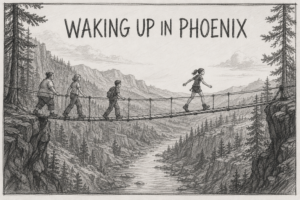
Waking Up in Phoenix
Christian-adjacent* coming-of-age adventure.
status:
Completed.
*"Christian-adjacent" is a term a friend used to describe this movie, since there is no violence, sex, drugs, smoking, or swearing—yet the characters do not mention God or Jesus.
In 2021 I wrote and directed a film called “Waking Up in Idaho” with an indie crew. Though the acting was excellent, the film as a whole did not live up to my vision, so I did not release it.
I feel the story deserves an audience, and have upgraded some sequences to take advantage of the capabilities of a professional Hollywood cast and crew. I offer “Waking Up in Phoenix” to be made by an established producer and director.
AnnaStarted Dec 2025.
, a bold 14-year-old Native American girl, and Boyd, her timid 15-year-old Caucasian foster brother, are abruptly separated after Anna’s act of rebellion gets them kicked out of their abusive foster home. Placed with two inexperienced single women, Peg and Lucy, the siblings struggle to adjust—until the foster moms decide to take them on a spontaneous three-day wilderness getaway. As the adults compete to be the “better” new mom, Anna is drawn toward a deeper connection with her Native roots, while Boyd is challenged to step into courage. The weekend swings between conflict and laughter—until a crisis in the wild forces all four to reexamine what family really means.

Jalan Jalan
Prestige Drama
status:
Completed.

Jalan
Jalan is an award-winning novel by British author Mike Stoner, inspired by sad events in his life and his time in Indonesia. In the story, James tries to forget his dead girlfriend, Laura, but at the same time he finds comfort in remembering her. Which is fairly easy, because she is a ghost haunting him—sometimes friendly, sometimes taunting him. In life, Laura often spoke playfully of mystical notions of time and space. Late in the story, James meets a shaman, who does some magic that makes James feel some hope. At the end of the story, we—and James—are led to believe it just might be possible that when he goes back to England, she may actually be alive and waiting for him. During this whole journey, James has subtle but powerful effects on the people he comes to know in Indonesia, because despite his tragic loss, his basic kindness and regard for others remains intact.
I found this book when I was looking up the meaning of the title of a song by the same name. It was such a beautiful story that I contacted the author and asked if I could write the screenplay.

500 word synopsis
Jalan Jalan follows James, a young Englishman who moves to Indonesia after the sudden death of his girlfriend, Laura, who was struck by a bus. The couple had planned to reunite after three months apart, but her tragic death leaves James grappling with deep grief. Taking a job as an English teacher, he tries to escape his pain, but Laura’s ghost haunts him, along with flashbacks of their time together.
In Indonesia, James forms bonds with the local expat teachers, including Kim, a carefree half-Vietnamese half-American man who pulls him into the chaotic nightlife of Medan. One night in a nightclub he meets Eka, a beautiful young Indian woman who advises him “No talk to dead girl.” (Laura). She knows James cannot commit to her, but she remains unwavering, as she helps him through moments of illness and confusion.
James’s job brings him into contact with Charles, a wealthy Chinese-Indonesian businessman, whose children, Fitri, 15, and Benny, 10, bond with James during their English lessons. Charles, protective and reserved, shares a deeper connection with James, as both men cope with past trauma—Charles is painfully estranged from his wife, but too proud to try to approach her.
A turning point occurs at Mei’s bar when Barry, an expat bully, confronts the teachers. A previously quiet teacher stands up to Barry, and the rest of the group supports him, forcing Barry to back down when his friends desert him.
During an excursion to the jungle to see orangutans, James stands up to a drunk Liverpudlian harassing a local girl. This act of courage contrasts with his usual introspection and marks significant personal growth.
Despite his deep loss and internal turmoil, James forms deep connections with both fellow teachers and local residents. He retains his capacity to care for others, resulting in a quiet but often profound healing impact on those around him.
In life, Laura was fascinated by the mystical possibilities of time and space and alternate realities. Through Charles, James meets a local shaman, who performs a magical ritual to remove Laura’s ghost and take away his pain. Her ghost seemingly disappears, replaced by a lingering sense that Laura may, against all odds, be waiting for James, alive and well, upon his return to England. This possibility, whether real or imagined, offers James a kind of hope, and the feeling that life, time, and love are far more fluid than he had once believed.
The Grief Ranch
Drama
status: Completed.

I was inspired Started 2013.
to write The Grief Ranch after witnessing the deep grief of a friend whose daughter died of a drug overdose. I struggled with this for years before I finally found a way to write a script that addressed it properly, without showing easy solutions for the characters, yet still being hopeful.
The Grief Ranch follows a group of strangers who gather at a remote ranch to cope with profound personal losses, each burdened by their grief in different ways. But when their expected therapist goes into early labor and is unable to join them, the group is left to face their grief without professional guidance. They must find strength within themselves and each other, sometimes intentionally and sometimes through raw, unplanned interactions.Years ago a close friend’s daughter died of a drug overdose, and I witnessed his extreme grief up close. It occurred to me that our society does not talk about grief, and I thought it might be helpful to explore it.

500 word synopsis
Main Characters:
Suzette: Struggling with banishment from her family after indirectly causing her sister’s death during a night of drinking, Suzette feels weighed down by overwhelming feelings of blame and guilt. Her attempt to take her own life at the ranch becomes a pivotal moment for the group.
Josh: At just 17, Josh is grappling with the recent death of his father, with whom he shared a deep bond. Josh is sometimes able to hear his father’s voice—though this phenomenon stops after he arrives at the ranch.
Teresa: A mother who recently lost both her husband and one of her young daughters, Teresa’s grief is compounded by her anger at God and her inability to care for her surviving children. Teresa’s growing interest in Josh’s ability to “connect” with his father leads her to question the finality of death and search for her own form of solace.
Mike: A high school coach and teacher, Mike is a broken man after the loss of his daughter to a drug overdose. His reluctance to face his emotions keeps him at arm’s length from the others, but his protective instincts kick in when Suzette’s life is at risk.
Allison: After her husband’s death, Allison’s anger toward his negligence in managing his diabetes consumes her. Though outwardly tough, she is deeply shaken by Suzette’s suicide attempt and becomes more engaged with the group as a result.
Kelly: Kelly is abrasive and over-controlling, projecting her unresolved grief over her son’s death onto the others. Her harshness leads to confrontations, but it also forces critical emotional breakthroughs, especially with Suzette.
The ranch itself is run by Rollie, the caretaker, and Earl, the ranch’s reluctant owner. Without a therapist to guide them, Rollie reluctantly steps into a leadership role, though he knows he’s out of his depth. Despite the absence of a professional, the group comes together, slowly building trust with one another.
A turning point occurs when Suzette attempts suicide one night. Paramedics arrive the next morning, offering to take her to the hospital, but Suzette insists on staying at the ranch. The group rallies around her, realizing they must support each other if they are to get through their individual battles with grief.
Two characters have deep secrets:
Earl lost a son to suicide, and left a successful career in the city to escape all memories of his old life.
Kelly’s son is not dead, but she tells people he died so she can avoid confronting the painful fact that she emotionally abused her son so much that he moved to Europe after high school and never spoke to her again.
Ultimately, The Grief Ranch explores how people can become accidental healers for one another, even in the absence of formal guidance. The ranch becomes less about structured therapy and more about the human connections forged through shared pain, guilt, and vulnerability. Each character is forced to confront their grief head-on, often with the help of someone else’s story or perspective. Together, they discover that healing can come from unexpected places, even if the wounds of loss never fully disappear.
Now writing
The Miracle Test
Medical Thriller
status:
80 pages written.
Choreographed the kick-ass ending where the FBI grabs the mastermind and the assassin is thwarted just in time from making her third kill.
Syracuse, New York: Immigrant pathologist Sandor Laszlo develops a medical test so precise it can detect cancer in a precursor stage. For $25, anyone could simply take the test yearly, treat the cancer precursor cheaply before the disease itself even appears. This would effectively make the whole industry of expensive medical scans, chemo, radiation and other treatments obsolete. Faced with losing billions in treatment revenue, physician-turned-investor Nelson Kraft—leader of a powerful medical conglomerate—has Laszlo killed before anyone finds out about the test. The killer—a nondescript but ruthless assassin named Martha—makes it look like an accident.
Journalist Susan Trowbridge is approached by her Haitian maid, Nadège, who is Laszlo’s neighbor and doesn’t believe his death was an accident. Susan’s husband Raymond, a physician, criticizes Susan for taking on this unpaid “sympathy task.” When Susan comes to suspect Nelson Kraft is behind the murder, he defends Kraft, who is a former radiologist and respected member of the medical community.
Susan takes her findings to federal authorities, but they are not convinced. She proceeds to gather more evidence, becoming a threat to Kraft and his businesses. Martha comes after Susan, planning another “accidental” death. Susan puts up a good fight, but the professional assassin is too much for her, and she is killed. Nadège consoles a grieving Raymond, who feels that Susan would be alive if he had believed her. Together they find hidden evidence in Laszlo’s apartment that Martha missed. It is not enough to implicate Kraft, but enough to start Raymond on his own investigation.
Just as Raymond finds the missing puzzle piece to convince the authorities, Martha starts a relentless hunt to kill him. After an “accidental death” attempt fails, time is against her, and a pistol becomes her weapon of choice. She pursues Raymond to a ceremony where Kraft is dedicating a new wing to the Cancer Center. As she points her hidden pistol at Raymond, the FBI crashes the event and takes Kraft into custody. With her reason to kill Raymond gone, and no prospect of being paid for the kill, she quietly slips out of the building. Raymond is safe, but left with grief and guilt, but Kraft will go to prison, and other scientists will develop Laszlo’s technology to help spot cancer and treat it before it even appears.
Seem farfetched? Medical researchers are now exploring such techniques as liquid biopsy, genomic/epigenetic blood tests, and synthetic biomarker sensors to do exactly what Laszlo’s test would do. He planned to sell his for $25. Wonder how much Nelson Kraft’s company would sell it for if he had it?

Scripts in Development
Feature projects at varying stages of development.
Up Next!
The Silent Treatment
Romantic Comedy
status:
Characters created.
Opening scenes written.
I know the ending—and I must say, it's hilarious.
I’m really excited about this one. Since it is a silent retreat, there will be little dialogue—only that of the counselors. The right director will love finding the comedy in the physical and the nonverbal, and I think it will be a unique treat for the audience as well.
At a silent retreat where speaking means immediate expulsion, a couple who split up a year earlier are each stunned to discover the other one there. Other participants detect the ill feelings. They rally behind one or the other, and petty sabotage escalates into a full-scale wordless war. At the end, the exes realize that had always let themselves be influenced too much by those around them, and they make up. But in the meantime all these “spiritual people”—attendees, counselors, and even the big guru himself—have lost their freaking minds and the camp is in a shambles!
The Sadhu
Thriller
status:
Writing notes.
A charismatic Indian holy man has long been quietly enhancing his followers’ spiritual experiences through a chemical compound engineered by a friend. A manufacturing accident — a worker running a batch too hot — produces something exponentially more powerful. The holy man recognizes what he has and begins distributing it selectively, controlling dosage and access. His followers begin exhibiting what can only be called superhuman abilities, akin to the legendary Hindu “siddhis”—attained through advanced spiritual practices.
The engineer who designed the original formula doesn’t know about the accident. He holds a weaker hand than he realizes.
When the British intelligence apparatus grasps that a chemical compound capable of giving ordinary people superhuman abilities is in circulation — and could reach any government, any army, any revolutionary movement in the world — an agent is dispatched to contain it.
The sadhu controls the only working formula, the supply chain, and a growing army of the enhanced. He is the threat, the gatekeeper, and possibly the most powerful individual on earth.
Slapstick
Techno Disaster
I will write this in 2027.
Another script informed by Michael Crichton’s techno-thrillers. When I first had this idea in 2021, it felt implausible, so I shelved it. Now it feels almost inevitable. I’m keeping the premise under wraps while I refine it.
Lexie Gets Kundalini
Comedy
status:
Had this concept years ago. Started getting more ideas on it recently.
A worker at a gym falls asleep on a malfunctioning hydromassage bed after hours, and six hours of full body vibration give her a kundaline experience. As sometimes happens in real life, the experience is disruptive before it becomes transformative. Lexie’s working class family describes it like this:
“What’s wrong with Lexie lately?”
“Oh, that poor girl—she got kundalini!”
A slightly more knowledgeable coworker diagnoses Lexie’s condition as kundalini, and ChatGPT confirms it. Unfortunately, from there on, Lexie listens not to voices of reason, but to her less than scrupulous boyfriend, who convinces her to sell the experience after hours at $50 a pop.
Eventually Lexie starts to consolidate her spiritual experience, but now she has to fix the chaottic physical experience she has created—for herself and for others.
Cool Moms
Outrageous Comedy
status:
Just an idea.
But, I already have the sequel!
Keeping this one a secret for now. But I’m laughing to myself as more ideas come and i write them down in preparation for outlining the story later.
TellTale
Limited Series
“Reading microexpressions… Subject is lying."
This story may seem like science fiction, but you’ll see it happen in real life before you know it!
status:
Treatment
NOTE: I actually don't want to write this, because it would take away from my other projects, but I'd be happy to pass it on to other writers for a "Created by" credit and a few bucks.
The basis of this story is the simple combination of technologies that in fact exist right now—into an app named “TellTale.” When scaled to smart phones, and coupled with smart glasses—the effects on society are massive, universal, and irreversible. At first, many groups are against it. The religious right rails against it. The ACLU says it is unconstitutional. Many people say it is a fraud, that it doesn’t really work. Entire countries ban TellTale.
The FCC, the FTC, and the Department of Justice all try to ban TellTale. But the FBI, the CIA, and the Department of Homeland Security all use it routinely, as do most teenagers. Because it works. TellTale is promptly taken off the market by Presidential decree—its effects are that devastating. Now hackers offer the previous, less reliable (but still functional) version on “jailbreaked” iPhones . (iPhones with unauthorized modifications to the iOS that allow unauthorized apps to run on them.) Israel, Vietnam, and the UAE sell android phones with their version of TellTale installed, though all three ban its use in their own countries by all but top officials, and that under strict guidelines. A Supreme Court justice is assassinated in an attempt to prevent the Court from reversing the Presidential ban, but the ban is declared unconstitutional, and TellTale goes back on the market.
“TellTale” will grip viewers’ attention, because they will realize this is NOT science fiction. This is technology we will see in the near future. The power of this story lies not in the machinations of governments and groups—although those will certainly be compellling. The true power of the story is how TellTale changes the lives of every individual who uses it and veryone they interact with. TellTale will cause chaos in schools and workplaces. It will cause fistfights in bars and other public spaces. And it won’t be stopped.
You’ll want to watch TellTale because you’ll want to be prepared for it when the real thing hits the market.
I dreamed up the basics of the story, then brainstormed story points and large scale potentials of TellTale, as well as a few individual and family stories. But this story is way too big for me to write. It will need a Hollywood writing team.
Inquiries are welcome, but I will give out further details only through an agent.
2000-word synopsis available to qualified producers/agents
Artistic Demons
Romantic Comedy
status:
Writing notes.
A struggling artist’s paintings go up in value when his fresh-out-of-rehab girlfriend paints little demons on them.
Biker Babes
Dramedy
status:
30 pages written.
Needs more research.
A 60-year-old woman motorcyclist grieving the death of her husband and is persuaded by a friend to do a cross-country ride. This can be paired with a documentary funded by Harley-Davidson on women motorcyclists.
Love Mankind
Romantic Comedy
status:
Opening scene written.
Need to visit Kathmandu.
A Nepalese monk is challenged to be spiritual out in the real world when his monastery is converted into a luxury hotel and he meets a freewheeling young French woman. They communicate using the English they both learned from a mobile phone video game.
(Young monks are often given a couple hours of phone time one day a week. I met an 18-year-old Bhutanese nun in India who had such a privilege—and yes, it had corrupted her.)
Algún Día (Someday)
Mother/Daughter Road Trip (in Spanish)
status:
12 pages written.
Pan-Mexico route mapped out.
When you realize your own best ideas have kept you stuck for years…maybe it’s time to embark on a real adventure—even if the idea did come from your 9-year-old daughter!
When I lived in Tijuana, Mexico, a friend told me this story: One day her 9-year-old daughter came to her and said, “Mommy, let’s move to Paris. All we need is a camping tent, and we can learn French on the Internet.” Inspired by this charming tale, I imagine an adventure where the pair can’t board a boat in Ensenada (on the west coast of Mexico), so they head all across the breadth of the country to catch a ship in Veracruz (on the east coast). Of course the mother initially says no to the idea, but after losing her job and a couple of other calamities, she decides it can’t be any worse than staying in Tijuana, and off they go!